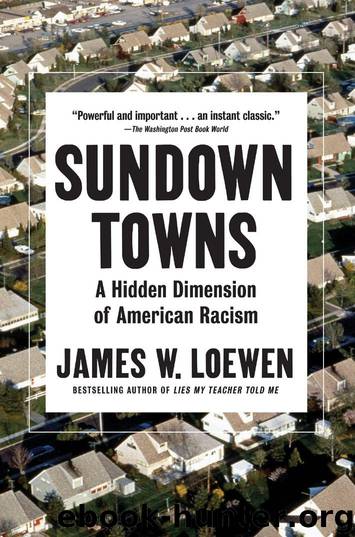
Sundown Towns: A Hidden Dimension of American Racism by James W. Loewen
Author:James W. Loewen
Language: eng
Format: azw3
Publisher: The New Press
Published: 2018-07-17T00:00:00+00:00
Zoning
Suburban incorporation gave suburbs power over zoning, which in turn conferred “unprecedented power to control development,” according to historian David Freund, which then played a key role in keeping suburbs white. Originally meant to keep out disamenities such as polluting industries, zoning became a tool to keep out the “wrong kind of people.” After such decisions as Lee Sing and Buchanan v. Warley (described in Chapter 4) made it more difficult to exclude blacks openly, suburban town governments soon saw that “regular” zoning might accomplish the same result, at least on a class basis. Beginning as early as 1900 and continuing “for many years,” sociologist Gary Orfield notes, “suburban governments used their zoning authority to exclude African Americans.” It was no accident that Edina became the first town in Minnesota to set in place a comprehensive zoning ordinance, Edina being the premier sundown suburb of Minneapolis–St. Paul. Cities like Edina banned mobile homes, public housing, subsidized housing, housing for the elderly, and apartments—and thus the kind of people who would live in such housing.63
In the New York metropolitan area in the mid-1970s, more than 99% of all undeveloped land zoned for residential use was restricted to single-family housing. The next step was to impose minimum acreage requirements for single-family homes. During the 1960s, more than 150 New Jersey suburbs increased their minimum lot sizes. In Connecticut, in 1978, more than 70% of all residentially zoned land carried a one-acre minimum lot size. Greenwich, an upper-class suburb of New York City, had a four-acre minimum. Much of St. Louis County surrounding St. Louis has a three-acre minimum. Given the cost of land in metropolitan areas, such large-lot zoning keeps out inexpensive homes and the people who might buy them. To make doubly sure, elite suburbs require new houses to be larger than a certain number of square feet or cost more than a certain amount. These economic measures could not keep out affluent African Americans, but the reputation they fostered for community elitism did.64
Incorporation also let local officials decide if their communities would participate in subsidized or public housing. “Most suburbs never created local housing authorities,” according to Michael Danielson, so they never got public housing. Some highly populated suburban counties did create public housing authorities but neglected to build any, he further points out. “DuPage County Housing Authority [just west of Chicago] was established in 1942, but had yet to construct a single unit 30 years later.” St. Louis County, which surrounds St. Louis on three sides, had 50 units of public housing in 1970 for a population of 956,000, while St. Louis city had 10,000 units for a population of 622,000. Even suburbs that do accept public housing often limit it to the elderly or require prior residence in the suburb for at least a year.65
Race, not the market, usually underlies suburban vetoes of public housing and subsidized housing. After a developer tried to build subsidized housing in Parma, a sundown suburb of Cleveland, voters in 1971 over-whelmingly endorsed a proposal requiring public approval for any subsidized housing project.
Download
This site does not store any files on its server. We only index and link to content provided by other sites. Please contact the content providers to delete copyright contents if any and email us, we'll remove relevant links or contents immediately.
| Anthropology | Archaeology |
| Philosophy | Politics & Government |
| Social Sciences | Sociology |
| Women's Studies |
Cecilia; Or, Memoirs of an Heiress — Volume 1 by Fanny Burney(32561)
The Great Music City by Andrea Baker(32021)
Cecilia; Or, Memoirs of an Heiress — Volume 2 by Fanny Burney(31958)
Cecilia; Or, Memoirs of an Heiress — Volume 3 by Fanny Burney(31944)
We're Going to Need More Wine by Gabrielle Union(19050)
All the Missing Girls by Megan Miranda(16038)
Pimp by Iceberg Slim(14515)
For the Love of Europe by Rick Steves(14149)
Bombshells: Glamour Girls of a Lifetime by Sullivan Steve(14078)
Talking to Strangers by Malcolm Gladwell(13375)
Norse Mythology by Gaiman Neil(13372)
Fifty Shades Freed by E L James(13245)
Mindhunter: Inside the FBI's Elite Serial Crime Unit by John E. Douglas & Mark Olshaker(9346)
Crazy Rich Asians by Kevin Kwan(9295)
The Lost Art of Listening by Michael P. Nichols(7507)
Enlightenment Now: The Case for Reason, Science, Humanism, and Progress by Steven Pinker(7315)
The Four Agreements by Don Miguel Ruiz(6767)
Bad Blood by John Carreyrou(6625)
Weapons of Math Destruction by Cathy O'Neil(6283)
